My son and I were recently at a local science museum, which was featuring an exhibit on space travel. There were options to craft paper rockets and blast them through rings of Mercury or Neptune by means of pressurized air. Mini pilot jackets and space navigation facts galore abounded the area.
There was a little station for gyroscopes. These enigmatic spinning tops pivot themselves off of tiny pedestal points and stay upright, even side-right, without losing their balance.

Gyroscopes are so powerful at staying balanced that they help keep aircraft stable. They can stabilize planes by maintaining orientation and reducing tilting movement.
After successfully revving one up and balancing it, Geo became more interested in transforming the tiny pedestal points into claws on his fingers. I picked up the balancing gyroscope and held it in my hands.
Its whirring was barely audible. Strangely, it felt like what I was holding was… alive.
It was almost like holding a baby bunny or a hamster. A force field was at work in the palms of my hand. But it was just a spinning gyroscope, a metal ‘toy’!

Somehow the phenomenon of rotation gives off a vibe of life.
In the solar system there is both rotation and revolution. Rotation, like the gyroscope demonstrates, revolves around a thing’s own axis. Revolution revolves around something else (like the sun).
All planets rotate around their own central axis as well as revolve around the sun. Each planet has its own rhythm of rotation. These various rhythms are unique to the planet. If the Earth had Venus’ rotation, then life would be barely recognizable, let alone sustainable. It takes Venus longer to rotate once on its axis than to complete one orbit of the Sun. A ‘day’ on Venus is 243 days. Imagine going that long without the soothing restoration of nightfall?
Earth’s rhythm makes our porridge just right.
Though we live thanks to the rhythms of planet Earth, our individual rhythms are also very unique. Some kind of central axis prompts us to spin and whir inside. If you sit quietly enough, you can sense yourself doing this, whirring like a gyroscope that knows how to stay on course. Where does this unique frequency come from?
Like the earth, we revolve around the sun. Everyone revolves around solar things: the light of love and meaning, purpose, and the warmth of connection and joy. These things are worth revolving around; this is universal. But what these things mean to us, individually and in our specific lives, is unique. This process is the internal dance of revolution and rotation, as real for the individual as it is to the universe.

Holding the gyroscope made me reflect on times as a child when I first held a little bunny or kitten. How awakening it was to hold a life. How natural it is to protect it. How strange the recognition of a life’s quiet and robust power.
If a gyroscope can stabilize an airplane and maintain its orientation, can our internal rhythms do the same for us?


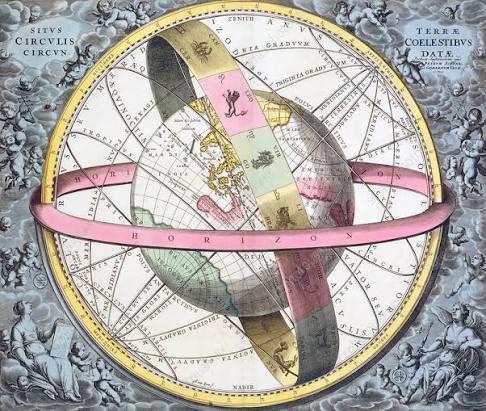
Featured art: Ptolemaic View of the Universe, Andreas Cellarius, 1708.⠀ My sister gave me a print of this years ago. It hangs above my couch, and I continue to love it more each year.




Leave a Reply